
How Sean Blanda Builds Custom Productivity Tools without Code
Read more

When I was tasked with starting a podcast at Freshpaint, I had one non-negotiable: it needs to be a valuable use of people's time.
You see, if you're not already aware, too many B2B marketers approach podcasts by following a simple, three-step recipe:
Whatever comes out of the process gets a title, a thumbnail, and a page on the company website that contains a few takeaways and an unedited transcript nobody will ever read.
The company gets to say it has a podcast. The guests are left to wonder if there was a point. And the intended audience gets "talking heads, talking shop" incoherently for an hour.
I outright refused to do that — and for good reason.
Freshpaint’s next stage of growth depended on healthcare marketers associating the company with helping them allocate budgets, prove return on ad spend, and more strategically acquire patients. Earning that reputation required credibility well beyond compliance.
The podcast had a job in that transition: give healthcare marketers a reason to trust Freshpaint’s judgment about measurement and performance. Leaving it to whatever happened after hitting record would’ve been a dereliction of my responsibility.
The stakes also explain why I put 10+ hours into every episode before hitting record.
Over the next seven sections, I’ll walk you through how to find a story worth telling, prepare the host and guest to tell it, and turn the conversation into articles, clips, and material your sales team can use.
You’ll also see what that work produced at Freshpaint, so you can judge where to invest the effort in your own show.
Freshpaint had a reason to make a podcast. I still needed to establish why a healthcare marketer would choose to listen to it. So I tasked ChatGPT with mapping the market for media targeting healthcare marketing professionals.
When the report came back, there was a first-mover advantage staring me back in the face. Healthcare marketers had a surplus of media telling them what mattered and why. Nothing told them what to do about it.
That gap showed up across the media landscape, from podcasts to newsletters, industry events, and trade publications. Feedback surveys from our House Call events and a handful of interviews with healthcare marketers pointed to an appetite for practical demonstrations worth emulating.
That insight gave the podcast a clear premise: take a specific piece of healthcare marketing work and unpack how it happened. Each episode needed to follow a campaign or initiative from the business problem through the decisions, internal hurdles, execution, and results. Healthcare marketers tuning in should leave with enough detail to apply the lessons to their own work.
That premise gave the podcast a name. The team floated a dozen names and I chose Marketing Rounds from those because it communicated the premise best.
Marketing Rounds was a play on medical rounds. But instead of moving from patient to patient, learning how to diagnose and treat illness, each episode would go from marketer to marketer, examining the problems they’d faced, the decisions they’d made, and how better marketing could improve healthcare.
That premise also shaped who belonged on the show — and who didn't:
We wanted marketers who owned or deeply influenced decisions and could:
We did NOT want marketers who only offered:
With these clearly defined guardrails, the next step was finding and booking guests to bring Marketing Rounds to life.
An embarrassing number of marketers skip the previous step and dive straight into booking guests. But let me tell you something...
Defining the podcast's premise and guest-fit criteria — and putting both in writing — made pre-production for Marketing Rounds substantially easier.
With those expectations out of my head, I had a handy rubric with dual purposes:
To source guests for Marketing Rounds, I first turned to my teammates in sales, customer success, and product over Slack. I equipped them with the guest-fit rubric and email templates they could use to reach out on my behalf.
Then I turned to AI for help sourcing guests. At Freshpaint, our centralized AI tools could search sales calls, customer-success and account-team conversations, CRM information, and other internal material for guest-fit signals. So I built an agent that managed two sub-agents — one to comb through Freshpaint sources and another using a web scraper pulling from a list of external sources.
Together, my fellow humans and my robot team accelerated the research — and made it easier for potential guests to say yes.
Thanks to the upfront work, my guest outreach was never vague because I had already gleaned:
By the time I invited healthcare marketers to be our guest on Marketing Rounds, I could point to a specific campaign or initiative to explore with Freshpaint CEO Ray Mina.
When vetting guests, that specificity also gave every guest-fit check call a starting point. Instead of wasting time throwing ideas at the wall, guests and I could dive right into my suggestion and use the rubric to establish whether it had the detail, results, and lessons an episode needed.
In fact, some calls lasted only 15 minutes because the rubric provided me with clear and defensible editorial judgement — not because they were a poor fit for Marketing Rounds, but because they were too early in the work to tell a complete story. In those cases, we mutually agreed to postpone their appearance until the story was ripe — and we could make a better episode together.
For guests moving forward, a 30-minute conversation often gave me enough material to shape the episode before we recorded it, allowing Freshpaint CEO Ray Mina to effortlessly switch between investor board presentations to podcast-hosting duties.
Want to know something that really grinds my gears? Watching self-proclaimed grammar Nazis make podcasts with zero regard (or awareness) that other mediums have grammar, too.
Finding a story worth hearing was one thing. Making it easy to follow was another. A listener driving to work couldn’t glance back a few paragraphs when something stopped making sense. Someone watching on YouTube could mash the "skip back 10 sec" button a few times, sure, but were they really?
This is all to say that I needed to shape the conversation so they could follow the story as it unfolded.
In an interview, the order of the questions matters. Ask about a decision before establishing the problem, and the answer loses its context. Introduce an unfamiliar term without explaining it, and the audience has to keep listening while trying to figure out what they missed.

To help Ray lead that conversation, I prepared an episode brief and a segmented interview guide. The brief established the story we wanted to tell. The guide laid out how to draw it out of the guest.
The episode brief gave Ray three things to orient himself before recording:
The interview guide then broke the story into segments. Each gave Ray enough direction to lead the conversation and judge when to dig deeper:
By now, you might reasonably wonder whether I'd built a podcast or invented a second full-time job. Ten-plus hours before hitting record is a substantial investment.
Was it worth all the effort?
I think so.
Remember that three-step recipe: book a guest, hit record, and pray something valuable happens? It's the go-to method for B2B marketers because it makes having a podcast the accomplishment. Whether or not anybody gets anything worthwhile out of it never crosses anybody's mind.
Marketing Rounds was more respectful of the time people gave it — that included the audience, the guests, Ray, and everyone working on the show.
Freshpaint, as you might recall, also needed to earn a particular reputation.
Healthcare marketers already associated it with privacy and compliance. Our next stage of growth depended on them trusting us to help allocate budgets, prove return on ad spend, and acquire patients more strategically.
Those expectations guided what happened after recording. Every title, clip, promotional post, and article needed to give healthcare marketers something useful, represent our guests’ work thoughtfully, and build Freshpaint’s credibility around measurement and performance.
Here’s how that shaped the way we packaged episodes, helped people discover them, and developed the material into other content after publication.
After recording, our podcast agency handled the technical production and editing. My editorial review included choosing the cold open — the interview excerpt played before the episode began — and the short-form clips to share on social.
I looked for moments when guests clearly articulated ideas that would build mental associations between Freshpaint and healthcare marketing performance: connecting campaigns to patient outcomes, making better investment decisions, and proving marketing’s contribution to the business.
Those excerpts helped put Freshpaint in the conversations we wanted the company to be known for. Getting someone to watch the full interview was a welcome outcome, but the clips had a job even when that didn’t happen. Someone encountering a guest’s perspective in their feed could leave with a useful idea — and another reason to associate Freshpaint with measurement and performance.
The episode page served people who preferred to read and deserved more than a few lousy takeaways and an error-ridden transcript. The format offered someone who never pressed play to get something worthwhile from the conversation. And it put Freshpaint in front of more buyers.
For promotion, I prepared material for the people who could help each episode reach a relevant audience:
That last part mattered. A rep needed to know which customer question the conversation could help answer. Giving them that context made it easier to put the material to use.
By publication, we had more than a finished episode. We had researched stories, detailed accounts of the work, and relationships with practitioners whose expertise could contribute to other Freshpaint programs.
That material took three main forms:
The research and preparation gave us the substance for these pieces. We could develop them from material already gathered, without asking guests to tell their stories again. We still shared the resulting work with guests to make sure they were comfortable with how we’d represented it.
Of course, producing more content doesn’t automatically justify the investment. Next, I’ll share the audience numbers, internal uses, and commercial influence that shaped my assessment of whether Marketing Rounds was worth the effort.
One of the most revealing signals came after we’d stopped recording, when a returning guest mentioned an email he’d received. I’ll get to that — but first, here’s what the audience numbers showed.
By the end of April 2026, 13 of the 14 episodes planned for the first round (aka what other podcasts call a "season") were published and the results looked promising.
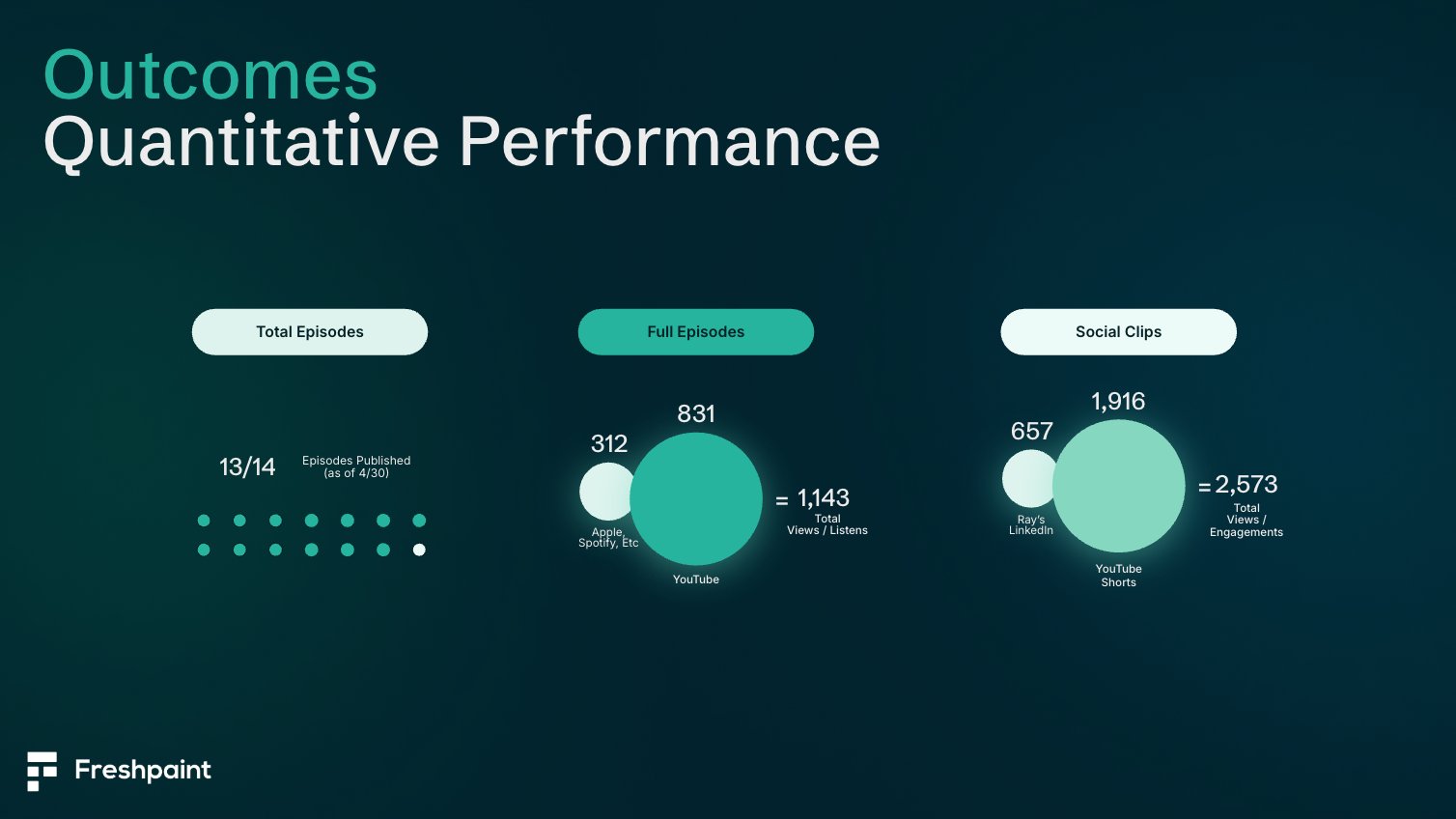
Those numbers showed people encountering and engaging with the material. Other signals helped us understand what they were getting from it.
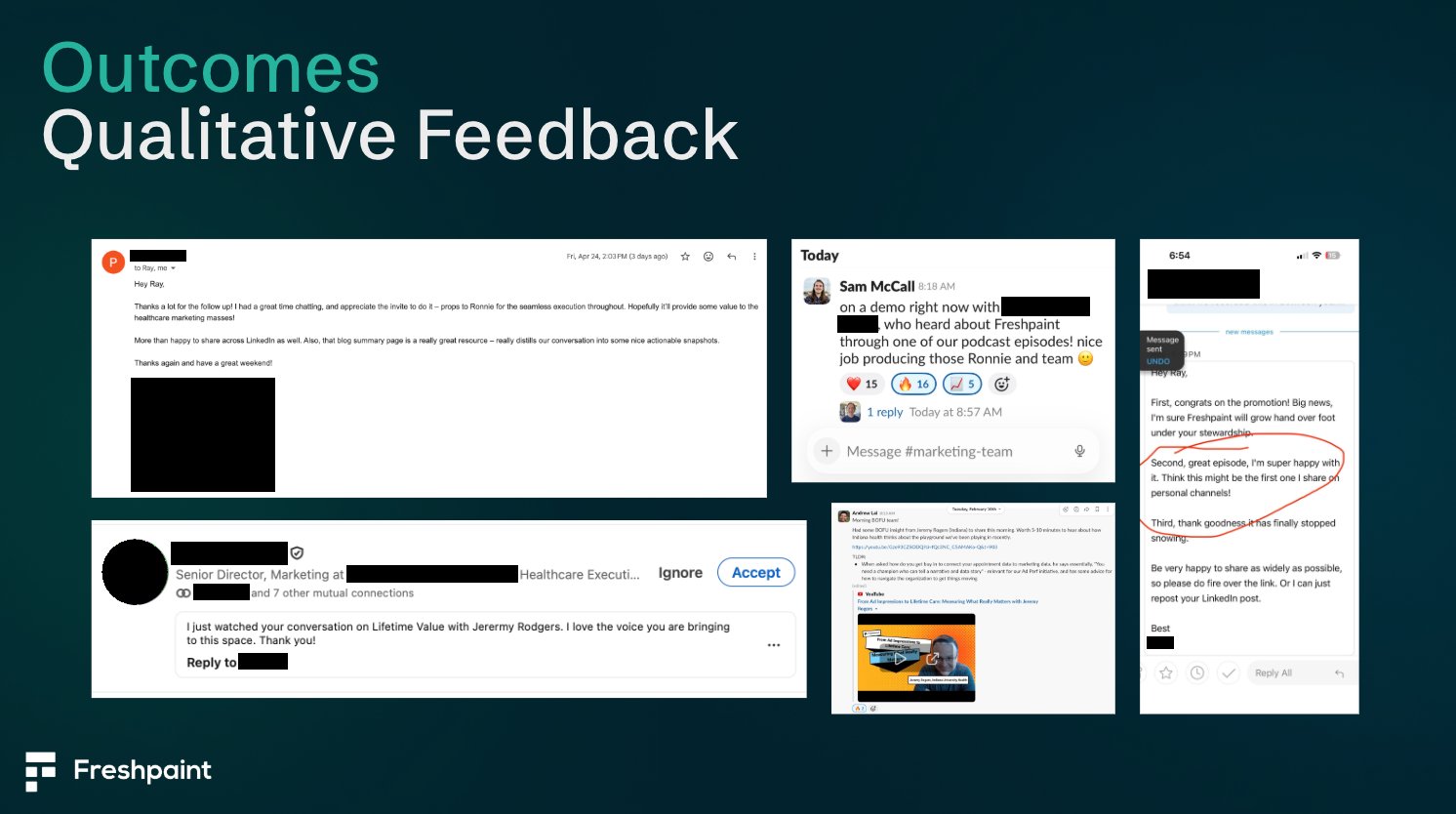
Healthcare marketers sent Ray connection requests mentioning the podcast. Guests praised the thoughtfulness of the interviews. One who usually avoided sharing podcast appearances made an exception for ours.
Inside Freshpaint, product and engineering colleagues shared episodes on Slack as inputs to product thinking. Sales and renewal conversations brought back mentions of the show, too.
Then, while recording our second round, Blair Primis, Chief Growth Officer at OrthoCarolina, told me something that made the commercial influence of Marketing Rounds tangible.
A marketing leader at a cosmetic-surgery brand had listened to his first-round episode and emailed asking who could help them accomplish what he’d described. Blair referred them to his Freshpaint account manager.
I checked HubSpot and saw the cosmetic-surgery brand was a substantial opportunity our team was already working to close.
I joked that Blair had just justified my employment and the project.
The opportunity was still active when I checked, so I can’t claim closed revenue. But I could trace a concrete path: someone heard a practitioner describe work they wanted to do, asked him for help, and received a referral to Freshpaint.
Before booking your next guest, choose one prospective episode and answer four questions:
Put those answers in writing. Share them with everyone helping make the episode. After publication, revisit them and change the next brief accordingly.
That gives you somewhere concrete to start — and a basis for deciding where your next hour is best spent.

Ronnie Higgins works in content strategy and production. At Freshpaint, he built and produced Marketing Rounds, developing practitioner interviews into material for the company’s broader content and marketing programs.

